
Disaster Response
Terminal 1, Terminal 2, and Terminal 3 are designed to be highly resistant to disasters such as fires.
In addition, we have equipped the airport with comprehensive disaster prevention facilities and have established an organizational structure and system centered around the disaster prevention center to ensure the safety of all airport users.
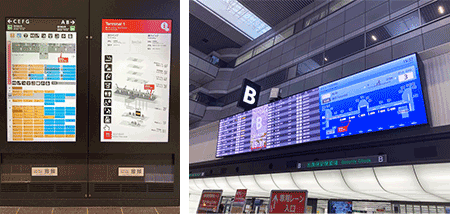
During disasters and emergencies, warnings and information will be displayed on monitors within the terminal.
Flights information and other displays will switch between Japanese and English depending on the situation.
- The display design varies depending on the signage. In addition, Terminal 3 (International Flights) displays information in four languages: Japanese, English, Chinese, and Korean.
Additionally, flashlights are installed on the ceilings of individual toilet stalls. These flashlights will alert passengers who cannot hear the terminal announcements to the occurrence of fires, earthquakes, and tsunamis.
When?
- Fire: When a fire breaks out
- Earthquake: When an earthquake of "weak 5" or higher is expected at Haneda Airport
- Large tsunami: When the Japan Meteorological Agency issues Major tsunami warning for the inner Tokyo Bay area.
If You Discover a Fire
If you discover a fire, remain calm and follow the steps below.
1Report
Please do not try to handle this alone. Speak loudly to let those around you and airport staff know what is happening.
Please make your initial call tothe Tokyo Fire Department at 119.
Please provide the location and specific details of the fire.
When making a report, please try to stay calm, speak slowly, and clearly.
- Example of a 119 Call
-
If you are asked, "This is the Tokyo Fire Department. Is this a fire or an emergency?"
Please tell them "There's a fire."
If you are asked, "What ward, what town, what block, what number, what number is that?"- In the case of T1 (Terminal 1), "This is the first passenger terminal building, 3-3-2 Haneda Airport, Ota-ku"
- In the case of T2 (Terminal 2), "This is the 2nd Passenger Terminal Building, 3-4-2 Haneda Airport, Ota-ku"
- In the case of T3 (Terminal 3), "This is the 3rd Passenger Terminal Building, 2-6-5 Haneda Airport, Ota-ku"
Please tell them.
When asked, "Where is it burning?"
Please tell them, "XX (store name, etc.) on the XX floor is on fire."
2Initial Fire Extinguishing
After informing those around you of the fire, grab a nearby fire extinguisher and try to put out the fire as soon as possible.
When extinguishing a fire in its initial stages, it is important to secure an escape route for yourself. Also, if the flames reach the ceiling (more than 2m), it is generally impossible to put out the fire with a fire extinguisher, so evacuate as quickly as possible.
In the event of a fire, the heat-sensitive part of the sprinkler melts and water is sprayed automatically.
How To Use a Fire Extinguisher
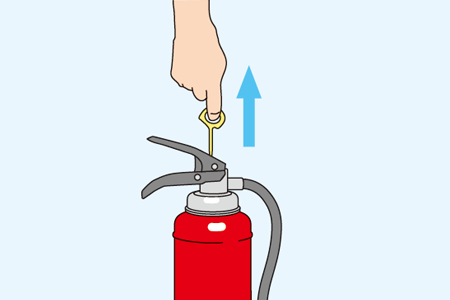
1. Transport the fire extinguisher to the source of the fire.
(Keep a distance of about 5 meters)
Pull the safety pin upwards.
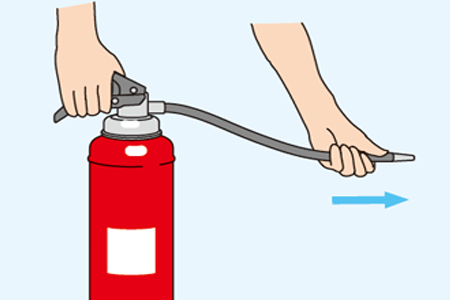
2. Point the nozzle near the source of the fire.
Keep the fire extinguisher about 5m away from the fire.
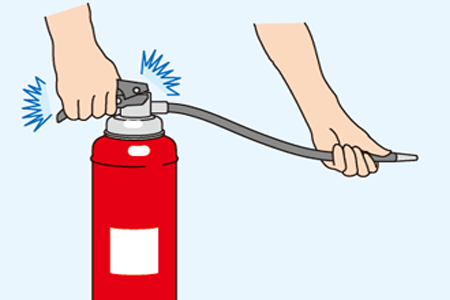
3. Squeeze the lever firmly.
A fire extinguisher can be used for approximately 15 to 20 seconds.
3Evacuation
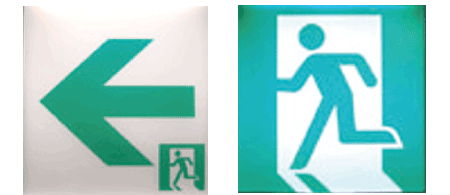
Evacuate in the opposite direction from the fire.
Use the emergency exit guide lights and passageway guide lights as landmarks to arrive at the nearest emergency exit.
- Please follow the instructions of airport staff when evacuating.
- Do not evacuate using elevators or escalators.
- Please give priority to the elderly, children, and people with disabilities.
- Once you have evacuated, do not return to retrieve valuables.
If Major Tsunami Warning Is Issued
At Haneda Airport, evacuation procedures will begin with the highest priority given to saving lives, triggered by the Japan Meteorological Agency's issuance of Major tsunami warning for the inner bay of Tokyo Bay, or by television and radio reports based on this warning.
The goal is to evacuate to an evacuation floor at an elevation of 10 meters or more above sea level within 10 minutes.
To the Primary Evacuation Site
When the Japan Meteorological Agency issues Major tsunami warning for the inner Tokyo Bay, an emergency broadcast (automated) will be made, so please begin evacuation.
After the automatic emergency announcement is made, the Disaster Prevention Center will make a live emergency announcement within the terminal with detailed information, so please remain calm and act accordingly, following the instructions of airport staff.
- If you are on an evacuation floor or higher, there is no need to go any higher.
- Please do not use escalators as there is a risk of secondary injury such as falling.
- Please exit any vehicle you are driving in Parking.
Evacuation floor 10m or higher
| T1 (Terminal 1) T2 (Terminal 2) Domestic Flights T2 (Terminal 2) International Flights T3 (Terminal 3) |
2nd floor or above |
|---|---|
| P1, P4, P5 Parking | 3rd floor or above |
- Emergency Broadcast (Automatic) Message
-
- T1 (Terminal 1)
Major tsunami warning has been issued. Those living in the basement or on the first floor should evacuate to the second floor. - T2 (Terminal 2)
Major tsunami warning has been issued. Anyone living between the basement and floor 1.5 should evacuate to the second floor. - T3 (Terminal 3)
Major tsunami warning has been issued. Guests on the first floor should follow the instructions of staff and remain calm while evacuating to the second floor. - multistory parking
Major tsunami warning has been issued. People on the first and second floors should evacuate to the third floor.
- T1 (Terminal 1)
Signage for Tsunami Evacuation Doors (Example)
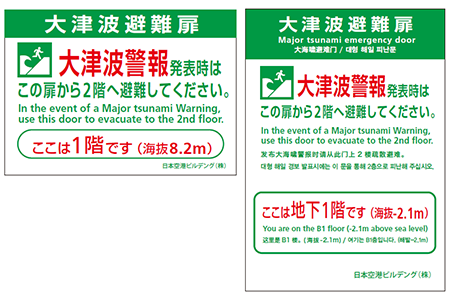
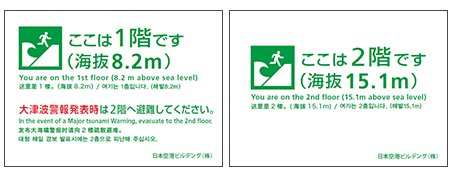
AED
Anyone can use AED.
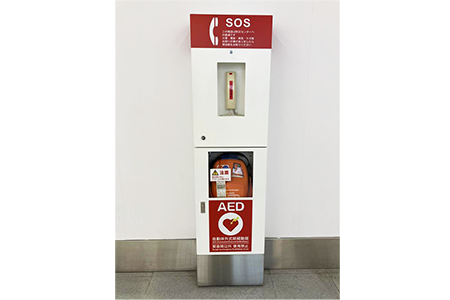
When you open the box door, a siren will sound. Take out AED inside and follow the voice guidance to operate it.
Features
- The system provides voice guidance for a series of operations, including attaching electrode pads, determining the appropriateness of defibrillation, and performing cardiopulmonary resuscitation (CPR).
- The electrode pads are stored pre-connected to the device, preventing incorrect connection of the electrode pads and loss of time in an emergency.
- The pad attachment indicator light allows you to check that the electrode pads are firmly attached.
- Once the electrode pads are attached, electrocardiogram analysis begins automatically, and charging occurs only when defibrillation is required.
- It's a one-button operation, just press the shock button.
- The adult/pediatric mode switch makes it suitable for a wide range of ages.
How to Use AED
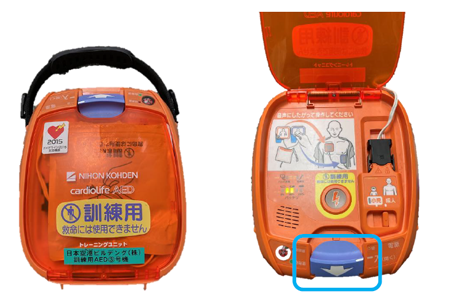
1. Open the lid and turn on the power.
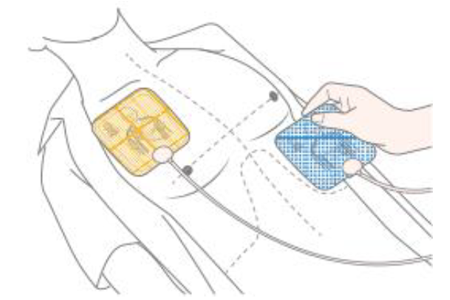
2. Remove the electrode pad bag and attach the electrode pad to your chest.
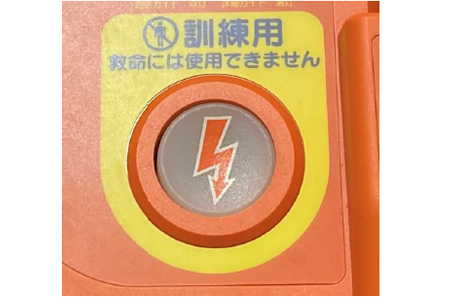
3. Press the button to receive an electric shock.
*To prevent electric shock, keep away from the patient when the power is on.
Hazard Map
Please see below for information on earthquakes and disaster prevention in Ota City.